
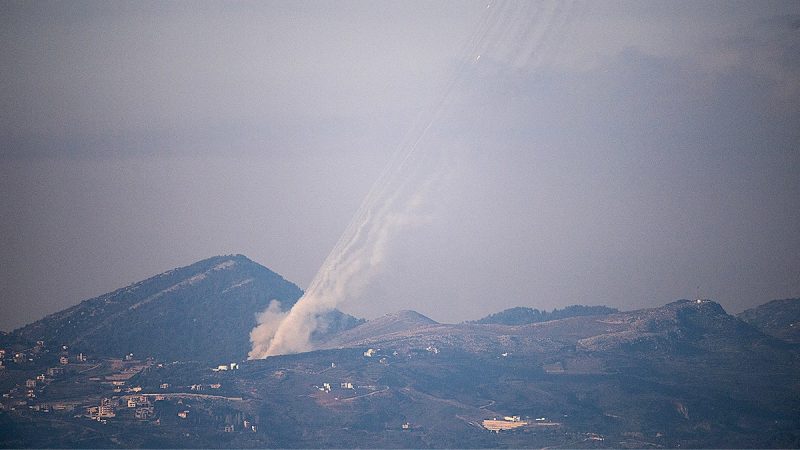
Hezbollah escalated its involvement in the widening conflict between Iran and the U.S. and Israel Tuesday, launching long-range missiles from Lebanon within 48 hours of coordinated strikes on Iran amid Operation Epic Fury.
The militant group also declared it was ready for an ‘open war,’ The Associated Press reported.
The Iranian-backed militant group fired rockets into northern Israel, prompting Israeli retaliation, according to The Times of Israel. Two were intercepted by air defenses, the military said.
‘Hezbollah is putting everything they have into the fight to add to the challenges Israel will face in this war,’ Ross Harrison, senior fellow at the Middle East Institute, told Fox News Digital.
‘But Hezbollah also knows that if the Iranian regime falls, they could be degraded,’ he said before highlighting that ‘Israel could not totally disarm Hezbollah.’
Hezbollah was formed in the early 1980s with Iranian backing during Lebanon’s civil war and has grown into Tehran’s most powerful proxy.
For decades, Iran has funded, armed and trained the group as part of its broader strategy to confront Israel and expand its regional influence.
‘Iran believes that it has to reestablish deterrence before the end of this war with the U.S. and Israel, so expanding it using Hezbollah and attacking Gulf Arab states and Cyprus is part of this,’ Harrison warned.
Israel responded to Hezbollah’s escalation with additional airstrikes on Beirut and expanded its ground operations, with the Israel Defense Forces (IDF) taking positions near the border.
The U.N. peacekeeping force in Lebanon reported seeing Israeli troops enter and exit Lebanese territory, though the IDF insisted its forces continue to operate there, according to The Associated Press.
The U.S. Embassy in Beirut also announced Tuesday that it would close until further notice in a post on X.
Israeli Defense Minister Israel Katz said, ‘To prevent the possibility of direct fire at Israeli communities, Prime Minister Benjamin Netanyahu and I have authorized the IDF to advance and hold additional dominant terrain in Lebanon and defend the border communities from there.
‘The IDF continues to operate forcefully against Hezbollah targets in Lebanon. The terrorist organization is paying and will pay a heavy price for the fire toward Israel.’
‘Hezbollah, this is an octopus. The head of the octopus is in Iran. The arms are all over the region,’ IDF spokesperson Effie Defrin told Fox News Digital.
‘Last night, they launched missiles into Haifa, into a city center in Israel. They started it, they knew the consequences of that.’
The IDF also announced that it had killed Daoud Ali Zadeh, commander of the Iranian Quds Force’s Lebanon Corps, in Tehran.
The Quds Force acts as a key liaison between Iran’s Islamic Revolutionary Guard Corps, or IRGC, and Hezbollah leadership, facilitating the transfer of advanced weaponry and enhancing proxy firepower.
‘The Quds Force is the arm of the Islamic Revolutionary Guard Corps, or IRGC, responsible for Iran’s relations with its allied militias, such as Hamas, Islamic Jihad, the Kata’ib Hezbollah in Iraq, Hezbollah in Lebanon and the Houthis in Yemen,’ Harrison clarified.
‘The Quds Force is the IRGC’s expeditionary force, designed to give Iran strategic depth,’ he said.
‘They are (or were) significant in managing Iran’s relations with shadowy militia organizations, and it has been challenged over the last couple of years as Hamas and Hezbollah have been degraded.’
On Saturday, the U.S.-Israeli airstrike campaign had also targeted Iranian leadership in Tehran, killing Iran’s Supreme Leader Ayatollah Ali Khamenei, dramatically escalating tensions across the Middle East and triggering regional retaliation.
An interim Leadership Council made up of President Masoud Pezeshkian, Chief Justice Gholam-Hossein Mohseni-Eje’i and Ayatollah Alireza Arafi is temporarily in charge of Iran, acting as the de facto head of state.
‘If Iran ends the war prematurely, then they believe the U.S. and Israel can come back later,’ Harrison said.
‘If they escalate, then they have a shot at recreating deterrence. It is a high risk, as it could bring them down. But the danger is they feel they have little choice, and Hezbollah is part of this for Iran.
‘If the Iranian regime can hang on, they win. That said, Iran cannot win militarily, but if they can deny the U.S. a victory, they win.
‘Fundamentally, the Iranian regime is trying to increase the pain of both Israel and the Gulf Arab states to be able to reestablish deterrence lost since the June 2025 war,’ Harrison added.
‘Attacking civilian areas and economic pain points alongside Hezbollah is also part of this strategy.’
Fox News’ Efrat Lachter contributed to this report.