
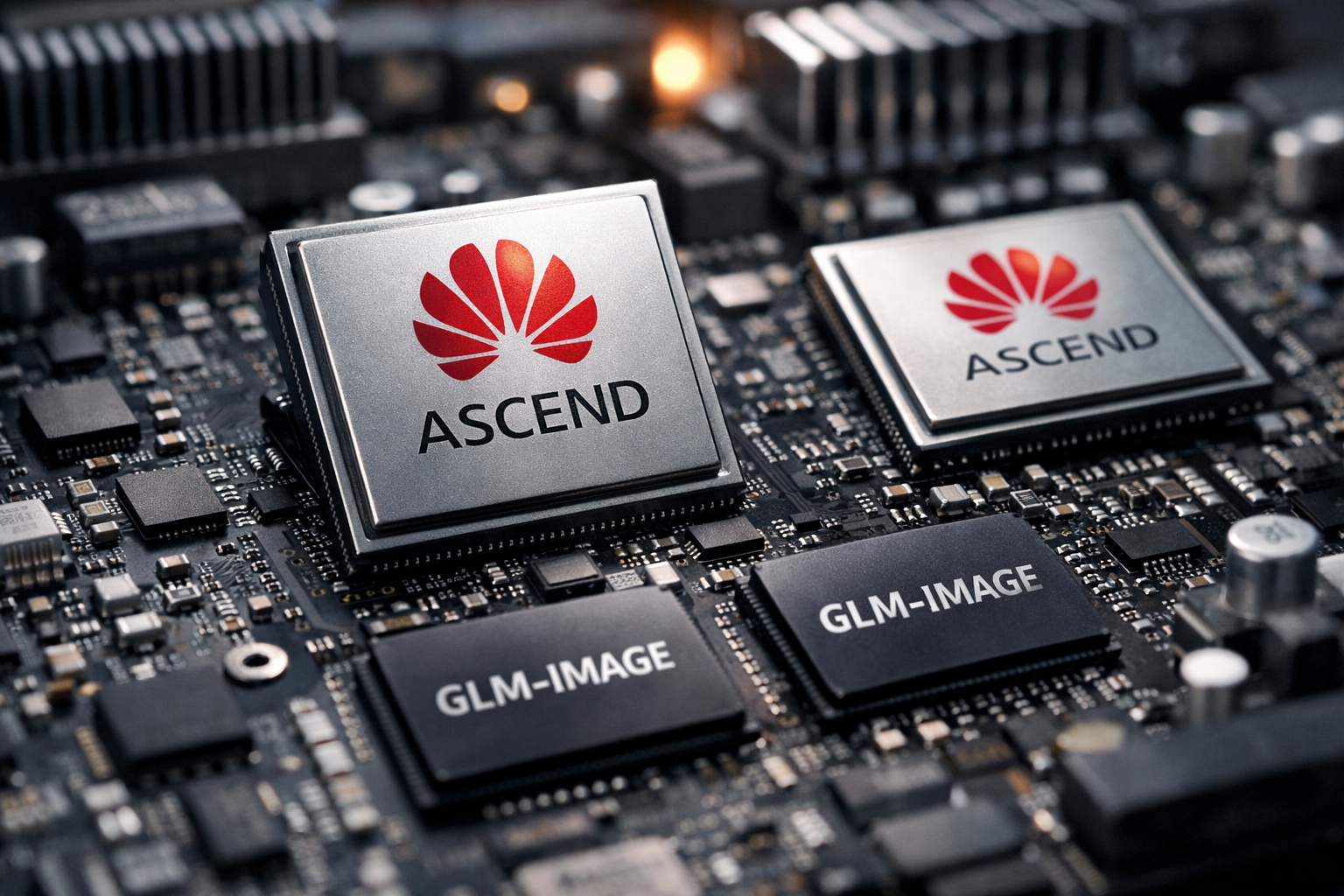
Knowledge Atlas Technology JSC Ltd., better known as Zhipu, announced on Wednesday that its open-source image generation model, GLM-Image, completed training using Huawei Technologies Co.’s Ascend chips.
The company described it as the first state-of-the-art multimodal model in China to reach this milestone on homegrown hardware, as the country works to build a more self-sufficient AI supply chain independent from the US.
Zhipu trains GLM-Image on Huawei Ascend
Zhipu said the training was carried out using Huawei’s Ascend Atlas 800T A2 server and the MindSpore framework, according to its statement.
The Ascend Atlas 800T A2 server includes Huawei’s Kunpeng-branded processors, alongside Ascend-branded AI chips, showing how China’s AI firms are increasingly relying on domestically developed full-stack computing systems.
The company said this achievement demonstrates that advanced multimodal generative AI training can be done using Chinese-built hardware and software platforms.
Domestic chips gain ground as sanctions bite
The announcement is a milestone for Huawei because no other major AI firms in China have publicly advertised success in training their models on domestic chips.
Huawei itself previously said in May last year that it trained its Pangu Pro MoE model on Ascend chips, highlighting the company’s efforts to prove its processors can handle large-scale AI workloads.
Zhipu was placed on a US blacklist last year, and since then, it has been accelerating work with domestic chipmakers, including Cambricon Technologies Corp., as it adapts and develops models that can run efficiently on Chinese semiconductors.
Nvidia export rules shift as China pushes self-reliance
Zhipu’s move comes as Beijing continues to promote local expertise and technology development, following years of efforts by the US and its allies to restrict China’s access to advanced Western chips and tools.
Hours before Zhipu highlighted its partnership with Huawei on Wednesday, the US moved closer to allowing Nvidia Corp. to sell its H200 artificial intelligence chips to China.
Washington issued revised criteria for winning approval to ship the processors to Chinese buyers, signalling a potential change in how some AI chip exports could be handled.
Even with shifting US rules, Beijing has extended support for the development, production, and adoption of homegrown AI chips, particularly as Nvidia’s most advanced semiconductors remain restricted.
IPO momentum lifts Zhipu shares
Last Thursday, Zhipu became the first of China’s major AI startups to go public.
Since the listing, Zhipu’s shares have jumped more than 80% as investors buy into growing enthusiasm around China’s AI industry and its domestic chip ambitions.
Huawei, widely seen as China’s top AI chipmaker, is preparing to sharply ramp up production of its most advanced semiconductors this year.
Cambricon, meanwhile, is preparing to more than triple its production of AI chips in 2026, adding to expectations of expanding local supply.
The post China’s Zhipu trains AI image model on Huawei Ascend chips amid sanctions appeared first on Invezz